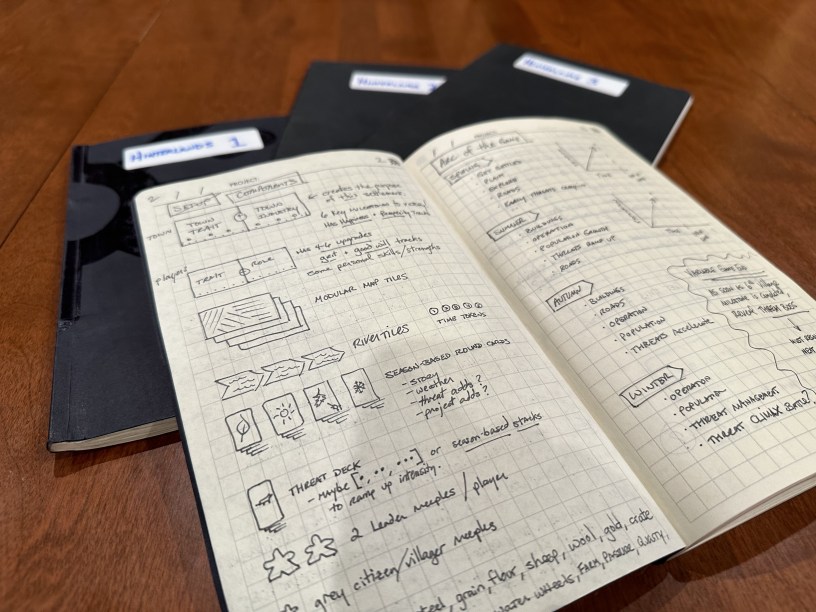
I get very frustrated when I play village-builder boardgames like Everdell or Hamlet: The Village-Building Game and we’re competing. It seems completely contrary to the idea that we all decided to seek out this new way of life together, to live as a community, yet we’re in direct competition.
Beyond a shared commitment to survive (Robinson Crusoe, Forbidden Desert, et al.) I haven’t yet seen a true cooperative village-building game.
On Second Thought: I suppose Dorf Romantik qualifies as a truly cooperative village-building game.
What is a cooperative boardgame?
I’ve heard it said that cooperative games are just solo games divided across multiple players. The game presents a puzzle and multiple players are not needed to solve it. One mind can take over, manage multiple pawns, and go through the steps for each player. This is called quarterbacking, when one player takes charge and starts telling the rest of the group what to do on their turns. The debate continues over whether quarterbacking is a problem with the game’s design or whether it’s the fault of the players choices.
Game designers have attempted to solve this in a variety of ways:
- limited communication (no talking, you can’t see your own cards, etc)
- simultaneous turns
- time constraints (there’s no time!)
- information overload (too much to consider for one person to process)
- semi-cooperation (we all win, but I’m the greatest winner)
- traitor mechanisms
- and more…
For more on this subject and to explore the full anatomy of cooperative game design, I highly recommend the book: Meeples Together: How and Why Cooperative Games Work by Christopher Allen & Shannon Appelcline
I’m not sure I’m going to solve it as a novice game designer, but the theme of Hinterlands is that we are the leaders of a settlement and it is our collective mission to establish ourselves in an untamed wilderness and become masters of our trade. We are each individuals who bring with us unique skills and our own individual life goals, but we are also a collective, striving together toward our common goal.
I want to explore this dichotomy a bit.
What makes Hinterlands a village-builder?
We are a Collective
At setup, you decide one Aspect and one Industry for your would-be village. These two elements will dictate not only your victory condition, but also force or guide some of the decisions you’ll make during the game.
Take The Black Forest Brewmeisters for example.
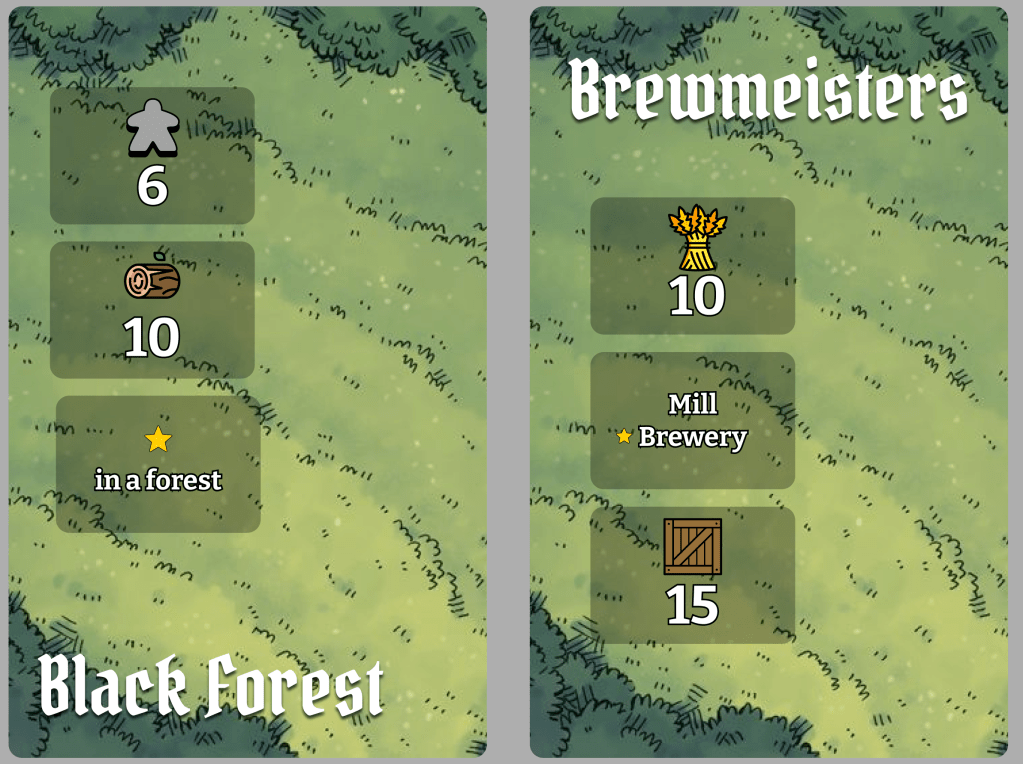
The Black Forest Aspect of your community desires you to grow your village population, stockpile lumber, and wishes to construct a primary industrial building in a forest. Meanwhile, your Brewmeister aspirations provide a blueprint for what it will take for you to establish yourselves as masters of your trade: gather grain (and by implication plant farms), construct a grain mill and brewery, and chain those buildings together to produce 15 crates of beer by Midwinter Night.
This structure allows players to randomize their Aspect and Industry from game to game, creating a variety of victory conditions that steer the game in different directions and toward different locales. When combined with a variable landscape, building locations and transportation networks will need to be worked out in different ways, making each game a slightly different puzzle.
We are Individuals
Each player is a combination of a Personality Trait and a Role. The Reckless Builder cares deeply about construction projects, but is more inclined to ignore a few threats or to take the risky options over the safe ones.
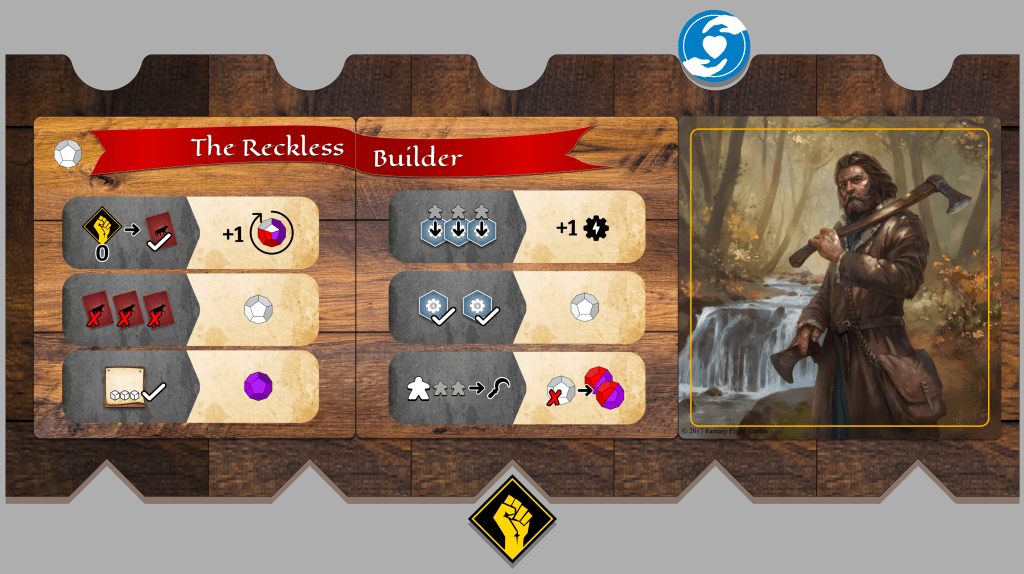
Only by satisfying your personal goals will you grow into your true self. Each time you satisfy one of your personal goals, you’ll unlock a new ability, gain more dice, extra actions, or some other upgrade.
The catch is that your personal goals might conflict with the reasons you decided to join this collective in the first place. The Legendary Shepherd might care deeply about raising sheep, but sheep have very little to do with brewing beer. Sometimes things line up nicely, and sometimes they don’t.
The tug-of-war between choosing the things you want for yourself and what you want for your community is central to the game.
Will your personal diversions ultimately benefit or doom us? Is it better to give up on the things you want for yourself to do what is for the greater good? Our lives, and the communities in which we all live, are full of these kinds of decisions.
Your Resolve is your ability to persevere, to resist, and to strive despite everything working against you. You can rest to regain Resolve and spend it to force your way to victory, but your Resolve is not limitless. If you’ve lost all your Resolve, you’ll have to be careful to avoid the hands of Fate.
A community is held together by the will of its members
Over the course of the game, new villagers will arrive, aiding you in your struggle, but a growing population will bring a new set of burdens that you must manage. The people will demand things of their leaders. If you’re ever going to become The Black Forest Brewmeisters, you’ll need to grow your village and make it into a place people want to call home.
Many hands make light work. Your choices and actions during the game will either earn you or lose you Good Will that you can cash in to gain the help of Villagers on future turns. Each Villager you hire for the round can provide you with free actions or aid you in combat against threats against the village. If you have no Good Will to spend, can you blame anybody for not wanting to do you any favors?
Solidarity: unity or agreement of feeling or action, especially among individuals with a common interest; mutual support within a group.
The level of Solidarity signifies the strength of your collective purpose. Carefully managing Solidarity will keep your village from dissolving. You’ll be presented with several opportunities over the course of the game to gain or lose Solidarity. If the Solidarity track ever reaches zero, the game ends in defeat. Your mission was two-fold: become The Black Forest Brewmeisters, but also make a place worth living in. You cannot continue without the will of the people.
You are incentivized to work together
Many cooperative games cordon off players into their own turns or isolate player actions to the individual. Examples include: Pandemic, Forbidden Desert, Robinson Crusoe. The coordination of these separated actions is what constitutes cooperation.
I’m interested in finding ways to blend player actions and to incentivize working together in specific, player-driven ways. I don’t have very much to share here beyond that sentiment, but here are a few ideas.
- On your turn you can pickup and carry another player’s pawn and bring it with you as you move.
- You can bring another player’s pawn into combat. You are the active player and they are a supporting player. You’ll both get to roll dice and engage in combat against the threat even though it all happens on your turn. You both could suffer when the threat fights back.
- For every person on a tile when an action is performed, the action is magnified.
- A single player might have an empowering aura encouraging other players to remain in their vicinity.
- Workers can act like a bucket brigade, transporting resources great distances despite a lack of established roadways.
- Multiple players can chip away at a threat over several rounds. For each player cube on the threat, they earn 1 Resolve or 1 Good Will when that threat is finally vanquished. Instead of counting cubes, the active player who vanquished the threat receives the written reward on the card.
Questions for the Audience
These are just a few of my attempts to tinker with cooperative game design and I’ll be sharing more thoughts in future diaries.
I’d love to hear some of your ideas.
- How would you create a strong sense of community?
- How would you incentivize cooperation?
- What games come to mind that embody the spirit of what I’m trying to accomplish with Hinterlands?
 Your Turn, Dad